Trust Center allows companies to share compliance documentation with prospective customers during security reviews and sales cycles.
As adoption grew, customers began encountering friction managing document access requests — particularly in identifying which requests required immediate attention.
Administrators often lacked the context needed to make timely decisions:
- whether the requester was tied to an active sales opportunity
- how important that request was to the business
- whether an NDA had already been signed, without requiring prospects to complete redundant agreements
As a result, important requests were sometimes missed or delayed, directly impacting deal progression.
At the same time, organizations lacked visibility into how their Trust Center was being used:
- which documents were most frequently requested or downloaded
- how visitors engaged with their Trust Center
- how Trust Center activity influenced sales outcomes
Trust Center is an important part of the sales process, but it wasn't supporting the decisions happening around it effectively.
I led the design of three interconnected initiatives — each targeting a distinct layer of friction in how organizations manage and demonstrate compliance — connecting compliance data, CRM context, and business insights into a single system.
- Connected Trust Center to CRM workflows — Designed the Salesforce integration that surfaces account, opportunity, and contact data directly within access requests, eliminating the need to switch tools
- Removed redundant friction in critical flows — Eliminated repeated NDA steps by checking CRM records and bypassing agreements when already in place
- Redefined access decisions through context + automation — Designed the logic and experience for evaluating and auto-approving requests based on CRM data (e.g., active opportunity + existing NDA), ensuring high-priority requests are not missed while reducing manual work
- Introduced visibility into product value — Designed the Trust Center analytics dashboard, surfacing usage, engagement, and revenue-related insights to help organizations understand impact
Trust Center access workflows were initially approached as an automation problem — reducing manual effort in reviewing and approving requests through CRM integration. Account Executives, Account Managers, and Customer Success Managers had important information about the vendors or prospects tied to a request, but the Trust Center Admin, that had to approve the requests, didn't, making it a fragmented, time-consuming process.
To better understand the opportunity space, we mapped opportunity areas using an Opportunity Solution Tree (OST), following Teresa Torre's framework, exploring how Trust Center could better support both compliance and sales workflows.

Opportunity Solution Tree — mapping high-impact areas across compliance and sales workflows
Through this process, three key areas emerged as high-impact:
- Improving access decision-making through CRM context
- Reducing friction in approval workflows (e.g., NDA handling)
- Providing visibility into Trust Center usage and business impact
To validate the approach, Group Product Manager and I led 5 moderated research sessions with customers, testing how they evaluated access requests and what information they needed to make approval decisions.
These sessions confirmed that surfacing CRM context — particularly opportunity stage, ownership, and NDA status — would significantly reduce friction and help teams prioritize requests tied to active deals.
Connecting Trust Center to CRM context
We designed the Salesforce integration to bring relevant CRM context directly into the access request workflow. Working closely with the PM, we defined what information would be most useful for decision-making, including:
- Contact and account information
- Associated opportunity and deal context
- Internal ownership (sales or customer success)
- NDA status
The design focused on how this information surfaced within the request experience — ensuring administrators could quickly understand the business context without leaving the workflow.
Access request panel with CRM context — account, opportunity, ownership, and NDA status surfaced directly in the workflow
With CRM data integrated, we could rethink how decisions were made. Administrators could now:
- Evaluate requests with full business context
- By-pass NDA when appropriate — Prospects were often required to sign an NDA to access documents, even when one already existed in their CRM. With this integration, our system would check Salesforce records for existing agreements and bypasses the NDA step if one was already on file.
- Auto-approve requests from prospects with a valid NDA on file, reducing friction at a moment directly tied to sales velocity, while maintaining compliance requirements.
This reduced both decision time and the risk of delaying important sales interactions.
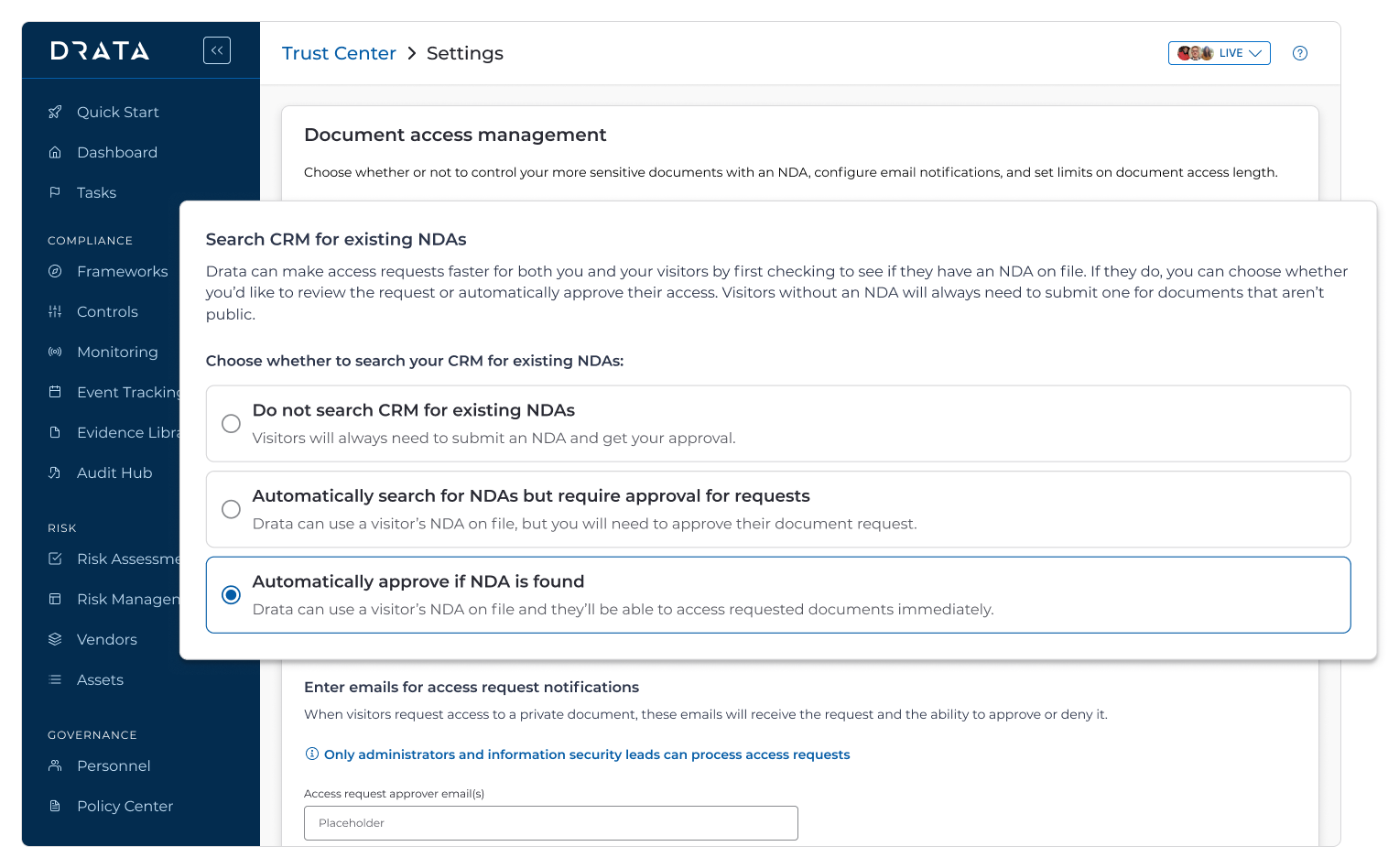
CRM settings — configuring the Salesforce integration and auto-approval logic
Auto-approval — requests from prospects with a valid NDA on file are approved automatically
Making product value visible
While automation improved operational workflows, customers still lacked visibility into how Trust Center contributed to their business.
I designed the Trust Center analytics dashboard to surface:
- Document downloads and access requests over time
- Trust Center page visits
- Engagement with specific documents (downloads and requests) — helping teams understand what content matters most and how to structure their Trust Center
- Opportunity stage distribution from their CRM tied to requests
- Revenue influenced by Trust Center activity
This gave organizations visibility into how their Trust Center was being used and how it contributed to sales activity.
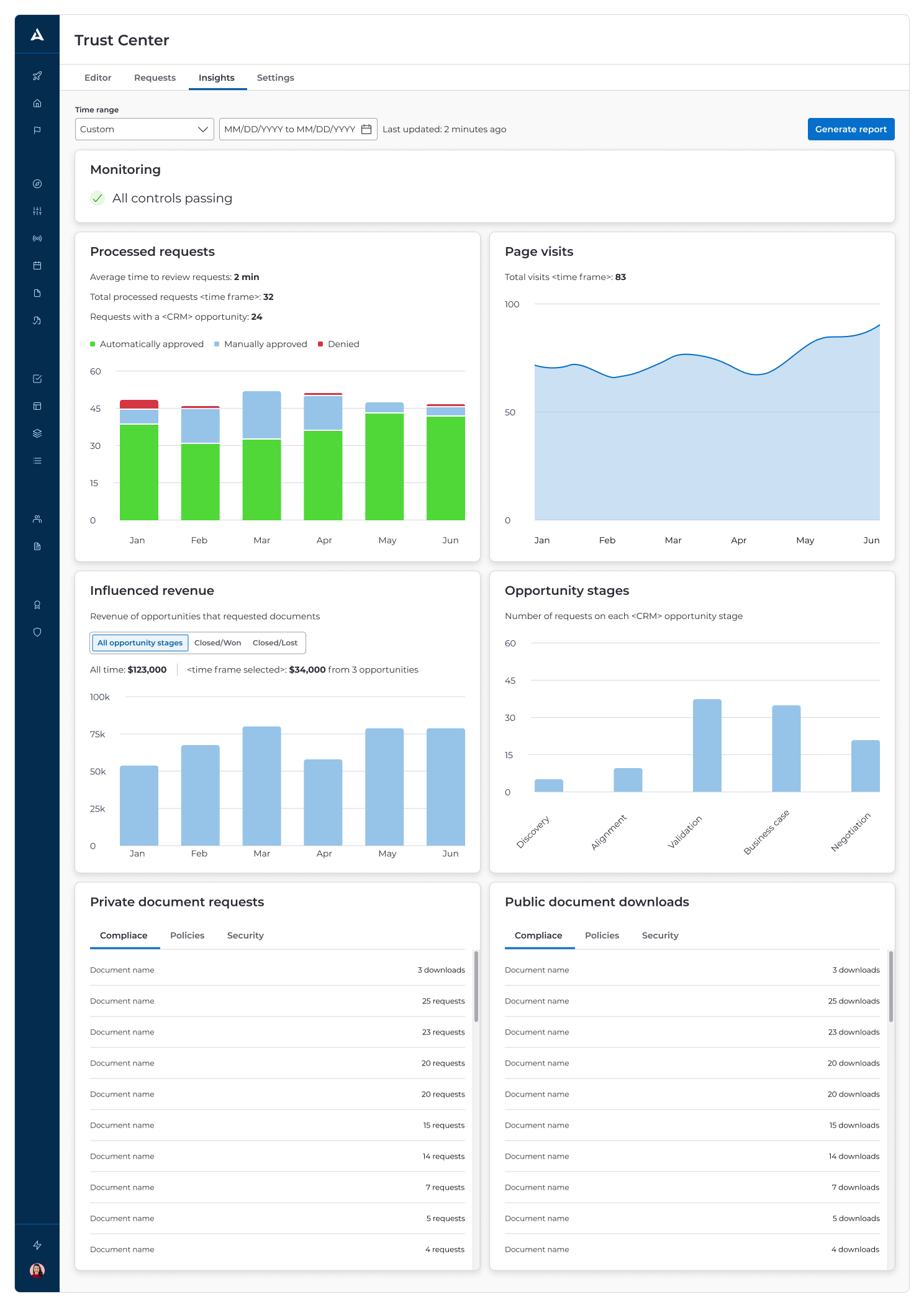
Analytics dashboard — usage, engagement, and revenue insights tied to Trust Center activity
This work transformed Trust Center into a system that supports how organizations present their security posture and manage access during active sales cycles.
- Reduced friction in gaining access to Trust Center documents for prospects and customers, improving the overall request experience
- Reduced manual verification work by surfacing CRM context directly within access requests
- Decreased manual effort through requests approval automation based on CRM logic
- Removed redundant friction in NDA processes, reducing delays during active sales cycles
- Enabled organizations to measure product impact through analytics tied to usage and revenue
- Provided tools for organizations to better understand Trust Center ROI.
This project proved how integrating with the tools our customers already rely on for critical data can meaningfully improve experiences within our product.
Although the problem initially surfaced as "important requests get lost" or "approvals take days or weeks," it quickly became clear that the root issue was fragmentation across systems.
Trust Center admins lacked context on which requests were tied to active prospects, what stage those deals were in, or whether an NDA was already on file. At the same time, Account Executives, Account Managers, and Customer Success Managers did have that context, but had to manually track down admins to get requests approved. What should have been a quick decision turned into a slow, back-and-forth process across teams.
At first, this felt like it could be solved through better notifications or messaging. But through research, we found that surfacing CRM data directly within the workflow provided far more value than increasing visibility alone.
Designing this experience required me to focus on how information flows across systems, and how those systems should interact. It reinforced the importance of designing for business context. By bringing CRM data and analytics into Trust Center, we enabled teams to make faster decisions and better understand how their Trust Center supports their sales process and brings value.